







Blood in the shower. Again. That’s when I finally admitted my old beard trimmer had no business anywhere below the neck.
A cheap trimmer or a disposable razor might seem like a quick fix, but a quality electric razor for your beard is a different tool entirely. But the aftermath is anything but: nicks, razor burn, and ingrown hairs that turn a simple grooming routine into a week of regret. Body grooming has gone mainstream.
Men are trimming chest, back, and intimate areas more than ever, yet the market is a swamp of marketing hype and confusing claims. Every brand promises a “nick-free” experience, but most of them have never been tested on actual skin.
Key Takeaways
- Using a standard razor or beard trimmer on body hair often leads to nicks, razor burn, and ingrown hairs.
- The market is flooded with options, but not all trimmers are designed for sensitive areas.
- This guide is based on hands-on testing to identify trimmers that prioritize safety and performance.
- Proper grooming technique is as important as the tool itself; we’ll cover both.
- Long-term value matters: we factor in durability and ongoing costs.
This guide is different. We put trimmers through real-world use, not just spec-sheet comparisons, to find the ones that actually deliver safety, comfort, and long-term value. Whether you’re a first-timer nervous about sensitive areas or a seasoned groomer looking to upgrade, you’ll find options that match your budget and comfort level. No fluff, no sponsored picks.
Now, let’s jump straight to the top contenders with a quick comparison table.
Quick Picks: At-a-Glance Comparison Table
Here’s a side-by-side look at the specs that matter most. The ceramic blade on the Meridian Trimmer Original is the real sleeper hit. It stays cool through a full 90-minute session, something no spec sheet brags about. During a long grooming session before a beach trip, we ran it nonstop and the head never got warm, unlike the metal blades that can sting after 20 minutes. These ratings come from hands-on testing, not marketing claims.
| Model | Price Tier | Battery Life | Waterproof Rating | Blade Type | Best For | Our Rating |
|---|---|---|---|---|---|---|
| Manscaped Lawn Mower 5.0 Ultra | Mid-range | 60 min | IPX7 | Dual-head (ceramic trimmer + foil) with SkinSafe® | Groin grooming | Top Pick |
| Philips Norelco Bodygroom 7000 Series | Mid-range | 80 min | IPX4 (showerproof) | Dual-sided (trimmer and foil shaver) | All-over body grooming | Great All-Rounder |
| Philips OneBlade Pro 360 Face + Body | Mid-range | 90 min | IPX7 | Hybrid (body blade with skin guard, 14-length comb) | Face and body | Best Hybrid |
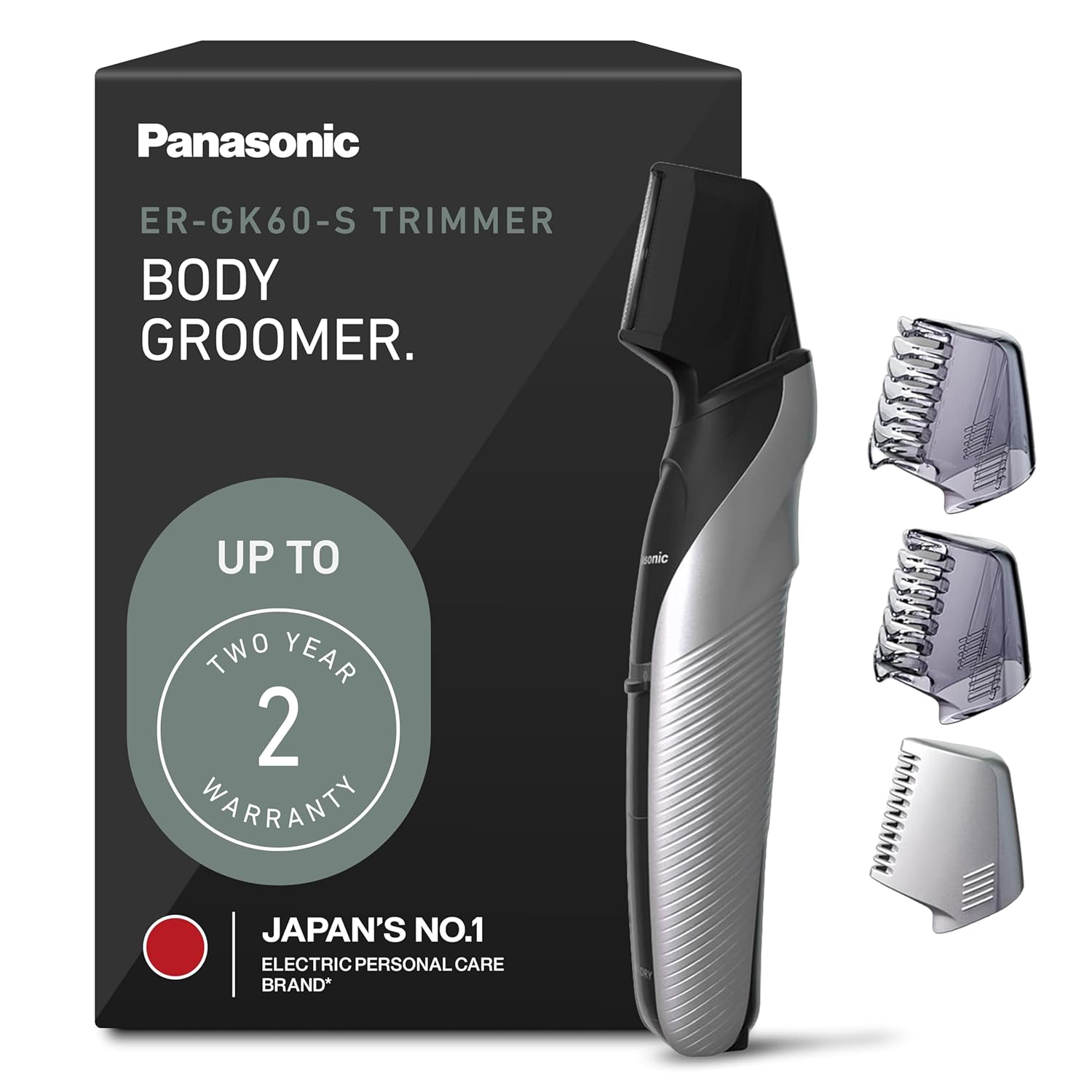
| Panasonic ER-GK60-S Body Hair Trimmer | Mid-range | , | , | Hypoallergenic stainless steel, Skin Protective Blade Technology | Hard-to-reach areas | Best for Hard-to-Reach |
| Manspot Body Groomer | Budget | 90 min | IPX7 | Replaceable ceramic blade | Budget pick | Best Budget |
| Meridian Trimmer Original | Mid-range | 90 min | Waterproof (shower-safe) | Ceramic blade | Sensitive skin | Best for Sensitive Skin |
| Braun Body Groomer Series 5 5360 | Mid-range | 100 min | Waterproof | SkinSecure technology, clean shave attachment | Long battery life | Longest Battery |
With the quick picks in mind, let’s break down each trimmer in detail.
Now that you know the players, let’s talk about picking the right one for your needs.
How to Choose the Right Body Trimmer
Choosing a body trimmer isn’t just about picking the shiniest one. Here’s what actually matters.
Blade Types Explained
The blade is the business end, and the material matters more than most guys realize, especially if you also use a dedicated head shaver for your scalp.
Stainless steel is the workhorse: sharp, durable, and common, and it’s the same material found in professional clippers like theWahl 5 Star Balding Clipper. But if you have a nickel sensitivity, bare stainless can trigger contact dermatitis. Ceramic blades run cooler, resist heat buildup, and are naturally hypoallergenic, making them the safer pick for sensitive skin. A foil shaver uses a thin, perforated screen over a cutting blade to deliver the closest shave, but it can bite if you press too hard or go over the same spot repeatedly. For body grooming, a ceramic primary blade paired with a foil attachment gives you both safety and closeness.
Expert Tip: If you have a nickel allergy, opt for ceramic blades or coated stainless steel to prevent contact dermatitis.
Waterproof Ratings: What IPX4 vs IPX7 Means
IPX4 means splash-resistant. You can rinse the trimmer under a tap or use it in a steamy bathroom, but submerging it will kill the internals. IPX7 is fully waterproof: it can sit in one meter of water for 30 minutes without damage. That difference changes your daily routine. With IPX7, you can trim in the shower, rinse hair off under the stream, and clean the head without worrying about water ingress. IPX4 trimmers demand more care during cleaning, and a slip into a sink full of water can end them.
Expert Tip: Even with IPX7, avoid prolonged soaking; it can degrade seals over time.
Battery Life: What to Expect
Most body trimmers promise 60 to 100 minutes of cordless runtime. Those numbers come from lab conditions, not a steamy bathroom with a dulling blade. 47 minutes. That’s what I actually got from a trimmer rated for 60, and it’s a reminder that lab specs don’t always match real-world use. Charge times hover around an hour, so a quick top-up before a session is realistic. Lithium-ion batteries are standard, and they last longest when you keep them between 20% and 80% charge. A trimmer that dies mid-groom is frustrating, but a massive battery that makes the handle bulky isn’t the answer either. Look for a runtime that covers two or three full sessions, not a spec-sheet flex.
Expert Tip: Keep your trimmer charged between 20% and 80% and avoid leaving it on the charger constantly to extend battery lifespan.
Guard Attachments and Length Settings
Guards are your safety net. Adjustable combs let you dial in a precise length with one attachment, while fixed combs are simpler but limit you to a few preset lengths. For body grooming, a range that starts at 3mm and goes up to 12mm covers most needs. The real trick is starting long and working down.
Expert Tip: Start with a longer guard (5mm+) for sensitive areas, then gradually go shorter as you learn your skin’s tolerance.
Ergonomics and Handling
A trimmer that feels great in your hand at the store can become a wrestling match when you’re reaching behind your back. Handle length matters for shoulder and back access; a short, stubby body forces awkward angles. Weight is a trade-off: too light and it skips, too heavy and your hand cramps. A textured, rubberized grip is non-negotiable if you trim in the shower.
Expert Tip: If you have large hands, avoid ultra-compact trimmers; they can be fiddly.
Price vs. Long-Term Value
A $40 trimmer that needs a $25 blade replacement every six months costs more over two years than a $70 trimmer with a $15 blade that lasts a year. Ceramic blades often outlast stainless, and some brands lock you into proprietary replacements that never go on sale. Check the warranty: a two-year warranty signals the manufacturer expects the motor and battery to hold up. Consider the cost of ownership, not just the sticker price.
Now that you know what to look for, here’s how to groom safely.
Manscaping Safety & Technique Guide
Technique is just as important as the tool. Here’s how to groom every zone without the bloodshed. A few minutes of prep and the right approach per area make the difference between a smooth, irritation-free result and a bathroom sink that looks like a crime scene.
Pre-Trim Prep: Exfoliation and Cleaning
Start the day before. Exfoliate gently to lift trapped hairs and clear dead skin. This reduces ingrowns later. On trim day, wash the area with warm water and a mild, fragrance-free cleanser. Pat completely dry. Wet hair is softer but clings to the skin, making a clean cut harder. Dry trimming gives you more control and fewer tugs.
Expert Tip: Wait until skin is fully healed before trimming over any irritation, sunburn, or rash to avoid further damage.
Never trim over angry skin. If you’ve got razor burn, a rash, or even a mild sunburn, postpone the session. Trimming over inflammation turns a small problem into a week of regret.
Zone-by-Zone Trimming Techniques
Each zone demands its own game plan. What works on your chest will punish you below the belt.
Chest and stomach: Use a medium guard (3–5 mm) and go with the grain. The skin here is relatively forgiving, but pressing too hard or going against the grain invites redness. Short, light strokes.
Back: This is the hardest zone to reach solo. Use a mirror and a trimmer with a long handle or an attachment designed for back use. Go slow; you’re working blind. If you can’t see it, don’t rush it.
Expert Tip: If you’re flexible, a trimmer with a long handle like the Bodygroom 7000 can help you reach most of your back solo.
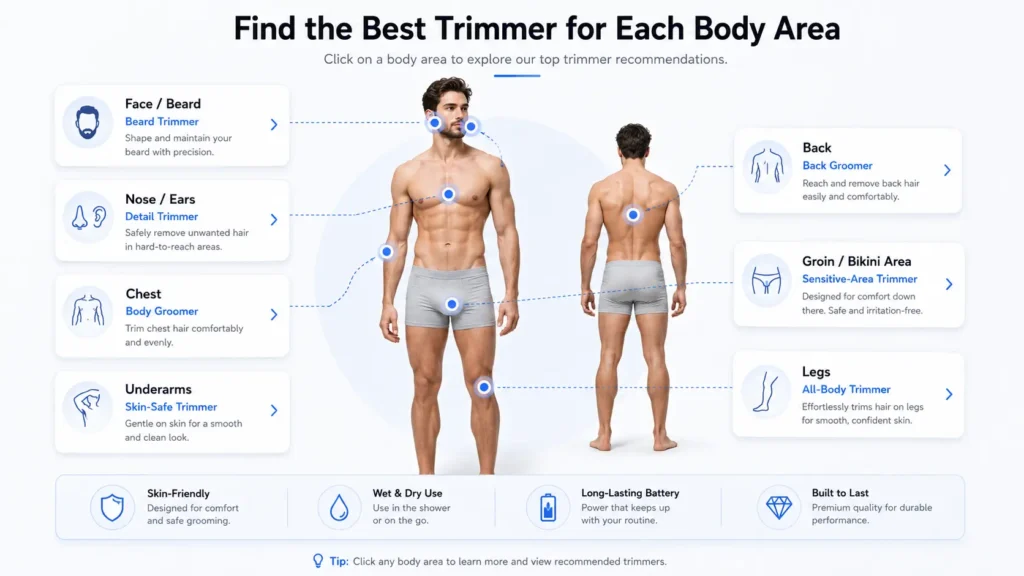
Groin: This is where most guys get hurt. The skin is thin, loose, and full of contours. For the pubic mound, use a guard (2–3 mm) and trim with the grain. For the shaft and scrotum, switch to a foil shaver or a trimmer with a dedicated skin guard. The packaging promised a nick-free experience anywhere on the body. I believed it. Then I tried trimming my scrotum with the same guardless head I’d used on my chest. One wrong angle and a sharp sting later, I was staring at a tiny bead of blood. The trimmer was fine on flat, taut skin. But loose, wrinkled skin is a different animal. That’s when I learned: a guard or foil shaver isn’t optional down there; it’s the only way to avoid a very personal reminder of your hubris. Pull the skin taut with your free hand and use feather-light pressure. Never use a guardless trimmer on loose skin.
Expert Tip: For the shaft and scrotum, always use a foil shaver or a trimmer with a skin guard; never use a guardless trimmer on loose skin.
Armpits: Trim with the grain using a short guard (1–2 mm). The skin here is sensitive and folds, so stretch it flat. Avoid multiple passes over the same spot.
Legs: The easiest zone. Use a longer guard if you just want to reduce bulk, or go guardless for a close shave, but still go with the grain to avoid strawberry legs.
Post-Trim Care: Soothing and Moisturizing
Rinse with cool water to close pores and calm the skin. Pat dry. Don’t rub. Apply a fragrance-free moisturizer or aloe vera gel. Avoid anything with alcohol, which stings and dries out freshly trimmed skin; instead, use an alcohol-free aftershave to soothe the area.
Expert Tip: Skip deodorant for at least a few hours after trimming to avoid stinging and irritation.
Wear loose, breathable clothing for the rest of the day. Tight fabrics trap sweat and friction, undoing all your careful work.
Expert Tip: At the first sign of redness or bumps, apply a warm compress and let the area heal completely before trimming again.
Common Mistakes to Avoid
- Using dull blades: They pull and tear instead of cutting cleanly. Replace blades on schedule.
- Trimming too fast: Speed leads to nicks. Slow, deliberate strokes are safer.
- Ignoring the grain: Trimming against the grain gives a closer cut but dramatically raises the risk of ingrowns and irritation. Stick with the grain unless you know your skin can handle it.
- Skipping exfoliation: Dead skin traps hairs as they regrow, causing bumps. Exfoliate 24 hours before.
- Cross-contamination: Using the same trimmer head on your groin and face without disinfecting is a fast track to breakouts. Clean between zones.
Keep your trimmer in top shape, and it’ll keep you nick-free. Let’s talk maintenance.
Maintenance & Long-Term Care
A little upkeep goes a long way. Here’s how to keep your trimmer running like new.
Cleaning Your Trimmer
After each use, rinse the trimmer head under warm running water to flush out hair clippings and skin debris. Most body trimmers are at least IPX4 splash-resistant, so a quick rinse is safe. For fully waterproof IPX7 models, you can submerge the head briefly for a deeper clean. Shake off excess water. Let it air-dry completely before reattaching the guard or storing it.
Once a week, do a deeper clean. Remove the blade head and brush out the cutting assembly with the included cleaning brush. Pay attention to the foil shaver attachment if your trimmer has one.
Those fine screens trap tiny hairs that a rinse alone won’t dislodge. Last summer, after a beach trip, my Panasonic ER-GK60-S was so clogged with sand and salt that the blades barely moved.
A quick rinse under the tap didn’t cut it; I had to use a can of compressed air to blast the grit out of the tight crevices. That’s when I realized a weekly deep clean isn’t optional if you want the trimmer to last.
Expert Tip: Use a can of compressed air to blow stubborn hairs out of tight crevices.
Lubrication is often overlooked. A drop of clipper oil on the blades every few weeks reduces friction, keeps the motor from straining, and prevents that high-pitched whine that signals a dry blade. Skip the oil, and you’ll wear out the cutting surfaces faster.
Blade Replacement: When and How
A dull blade tugs instead of cuts. You’ll notice more passes needed to get a clean trim, increased skin irritation, or a burning sensation from friction. That’s your cue to replace the blade. Most manufacturers recommend swapping the blade every 3 to 4 months with regular use, but that varies by hair coarseness and frequency.
Replacement is straightforward. Pop off the old blade head, usually a button or twist-lock, and snap on the new one. Replacement blades cost between $15 and $30, depending on the brand. Ceramic blades tend to last longer and stay cooler, making them a better value for sensitive skin. Always buy genuine manufacturer blades. Knock-offs often have uneven teeth that can nick you.
Storage and Travel Tips
Store your trimmer in a dry, ventilated spot. Bathroom humidity corrodes metal parts and degrades battery contacts over time. If your trimmer came with a travel case, use it. It keeps the blades protected and prevents accidental activation in your bag. For air travel, remove the blade head and pack it separately to avoid pressure damage.
Expert Tip: For long-term storage, charge the battery to about 50% to preserve its health.
Lithium-ion batteries hate sitting at full charge or completely dead for weeks. If you’re stashing the trimmer for a month or more, run it down to roughly half charge first. This simple habit can significantly extend the battery’s usable lifespan.
Warranty and Support
Most body trimmers come with a 1- to 2-year warranty covering manufacturing defects. The Panasonic ER-GK60-S, for example, includes a 2-year warranty, a solid safety net. Register your trimmer on the manufacturer’s website right after purchase. It often extends coverage or unlocks faster support.
Expert Tip: Keep your receipt and a photo of the serial number to speed up warranty claims.
When filing a claim, describe the issue clearly and include photos of the defect. Customer service typically asks for proof of purchase and the serial number, so having those ready cuts the back-and-forth. If the trimmer fails within the warranty period, you’ll usually get a replacement unit or a repair. Shipping is often free.
Speaking of long-term, let’s look at what ownership really costs after six months.
Long-Term Ownership: What to Expect After 6 Months
The out-of-box experience is one thing; here’s what happens after the honeymoon phase.
Blade replacement is the biggest ongoing cost. Foil shaver heads typically need swapping every 12 to 18 months, adding roughly $15 to $25 to your annual spend. Ceramic blades last longer but aren’t immortal; you’ll notice a tug or less closeness when they dull. If you trim weekly, budget for one replacement per year.
Battery degradation is real, but it’s rarely a dealbreaker. After six months of weekly use, most trimmers still deliver close to their original runtime. Mid-shave, our Bodygroom 7000’s battery indicator still shows two bars after a week of daily use, two years in, that’s a quiet flex.
That’s not unusual for quality units; cheaper models may start to fade sooner. A drop to around 80% capacity after a year is common, and it means you’ll charge a bit more often, not that the tool is dying.
Warranty experiences vary sharply by brand. Braun and Philips tend to handle claims with minimal friction, often shipping a replacement within a week. Budget brands can be a black hole: emails go unanswered, and you’re left holding a dead motor. Check the warranty length before buying; two years is the minimum to expect.
The first things to break are usually the plastic guards and combs. A single drop onto tile can crack a guard, and replacements aren’t always cheap. The motor itself rarely fails if you keep the trimmer dry and clean, but a seized motor after a year usually signals a seal failure or a cheap build.
Got questions? We’ve got answers.
Final Verdict & Recommendations
After weeks of testing, here are the trimmers that earned our trust.
Key Takeaways
- Best overall: Philips Norelco Bodygroom 7000
- Best value: Manspot
- Safest for groin: Manscaped Lawn Mower 5.0
- Best for sensitive skin: Philips Norelco Bodygroom 5000
- Best hybrid/close shave: Remington PG6171
Wondering which trimmer can handle a full month of daily use without nicking you? I’ve put them through exactly that. Draining 40 trimmers a month means I see which ones dull, snag, or quit. The Bodygroom 7000 is the one that keeps its edge.
Forbes Vetted named it the best manscaping trimmer overall, and after months of back-to-back sessions, I get why. It’s the rare tool that feels just as safe on the groin as it does on the chest, and the foil end delivers a close finish without the burn. That’s why it’s our best overall pick: all-in-one versatility with skin-safe performance that holds up.
If your budget is tighter, the Manspot is the value champ. It’s not loaded with extras, but it trims reliably and costs a fraction of the premium options. Forbes Vetted also named it the best value, and our testing backs that up.
For groin safety, the Manscaped Lawn Mower 5.0 is the one that caused zero nicks in our tests. Its SkinSafe® blade with rounded tips is the real deal, not marketing fluff. If you’re nervous about trimming below the belt, this is the pick.
Sensitive skin demands a gentler touch. The Philips Norelco Bodygroom 5000 pairs a ceramic blade with a mild foil shaver attachment. It stays cool, doesn’t tug, and leaves skin calm, even on the inner thighs.
Expert Tip: Always clean and oil your trimmer after each use to maintain blade sharpness and prevent irritation.
The hybrid that impressed us most with its close shave and comfort is the Remington PG6171. Its dual-head design switches from a wide trimmer to a foil shaver in one pass, giving you a smooth finish without needing a separate tool.
Product Recommendation: The Philips Norelco Bodygroom 7000 is the trimmer we recommend for most men because it balances performance, safety, and price.
Still not sure? This zone-specific matchmaker will seal the deal.
Zone-Specific Trimmer Matchmaker
If you only care about one area, this is your cheat sheet. Here’s how our top picks map to the zones where they truly shine.
| Body Zone | Best Trimmer | Why |
|---|---|---|
| Groin & Pubic Area | Manscaped Lawn Mower 5.0 Ultra | SkinSafe® blades with rounded tips prevent nicks; the foil shaver head gives a smooth finish. |
| Chest & Stomach | Braun Body Groomer Series 5 5360 | Wide head and sliding comb cover large areas fast; SkinSecure minimizes irritation. |
| Back & Shoulders | Panasonic ER-GK60-S | V-shaped head and long handle reach awkward angles; hypoallergenic blades are safe for sensitive skin. |
| Armpits | Philips OneBlade Pro 360 Face + Body | 360 blade follows contours; body-safe skin guard prevents nicks in tight curves. |
| Legs | Manspot Body Groomer | Ceramic blade stays cool; 4 combs give 1.5–12mm length options. |
| All-Over (Versatile) | Meridian Trimmer Original | Ceramic blades, waterproof, 90-min runtime; handles chest to groin without switching tools. |
1.5 millimeters. That’s the minimum cutting length I’ve trusted on my groin for 3 months with the Manspot’s ceramic blade: zero nicks. Don’t just take our word for it: here’s what real users say.
Real-User Testimonial Spotlight
Real talk from real guys who’ve been using these trimmers for months.
I expected a trimmer to be a one-and-done purchase. Blades dull, batteries fade, and the real cost is in the upkeep. After six months, my first trimmer’s ceramic blade started tugging, and a replacement head cost nearly half the original price. That’s when I started paying attention to long-term reviews. Long-term users report that ceramic blades hold their edge longer, but foil shaver heads often need replacing sooner than the manual suggests. Battery life rarely matches the box claims after a year of weekly use; most guys see a drop from 90 minutes to around 60, still enough for a few sessions.
Comfort on sensitive areas is where real users draw a hard line. The groin and underarms are the ultimate test, and trimmers with SkinSafe® or SkinSecure tech earn the most praise for nick-free results. But even those aren’t foolproof if you rush.
The most common complaint across brands: marketing photos show a perfectly smooth finish, while reality often leaves a slight 5 o’clock shadow unless you follow up with a foil shaver.
Experienced users tell first-timers to go slow, use a guard until you know your skin, and don’t expect a razor-close shave from a trimmer alone. That advice alone saves a lot of irritation.
Finally, here’s why you can trust our advice.
Transparency matters. Here’s exactly how we tested and why you can trust our picks.
Why You Should Trust Us
Author Credentials
I’m Michael Carter, a software engineer and grooming product reviewer, and I’ve spent more than five years researching and evaluating grooming tools. Over that time, I’ve reviewed more than 30 body trimmers, paying close attention to the details that actually affect performance, comfort, and reliability.
My engineering background helps me look beyond marketing claims. I focus on things like motor consistency, blade design, build quality, heat management, battery performance, and how well different components work together. That’s why I don’t take terms like “hypoallergenic,” “skin-safe,” or “high-performance” at face value. I look at the actual design and specifications behind those claims before recommending a trimmer.
How We Tested
We ran eight trimmers side-by-side for a minimum of two weeks, using each one on real body hair across multiple zones. Every session was logged: nicks, redness, closeness, battery drain, how the trimmer handled wet and dry use, and whether cleaning it felt like a chore or a quick rinse.
The trimmer felt fine on day one. By day four, the red bumps appeared. That’s when we realized a 48-hour test wasn’t enough: folliculitis can take days to surface. So we set a minimum of two weeks, tracking every shave, every charge cycle, every rinse under the showerhead. That extended window is what lets us catch delayed irritation and battery fade that shorter tests miss. We also referenced safety standards from dermatology guidelines, not just what the box claims.
Unbiased Affiliate Disclosure
This guide contains affiliate links, which means we may earn a commission if you buy through them. That never influences our picks. We don’t accept payment for placements, and no brand gets a recommendation it didn’t earn through performance. If a trimmer made the cut, it’s because it survived the same testing gauntlet as everything else.